
Inside Ripley Property Tax Records
Three county offices divide the work. The Assessor identifies and values each parcel. The Auditor applies deductions and keeps the transfer and tax accounting. The Treasurer bills and collects the money. That split is why Ripley County property tax records live in more than one place. Begin every lookup with the year and parcel number. Then match the value fields to the billing fields.
| Field | What It Shows | Where |
|---|---|---|
| Assessed value | The value used in Indiana's tax calculation for the stated year. | Assessor and GIS property card |
| Net assessed value | Value after applicable deductions or exemptions used in the bill calculation. | Tax statement and county accounting |
| Deductions and credits | Approved forms of tax relief tied to eligibility and filing. | Auditor and DLGF forms |
| Tax due and payment status | Installment amount, payment, penalty, or delinquency information. | Treasurer-linked tax lookup |
| Tax rate and district | The certified rate and levy context for the parcel's district. | DLGF county materials |
Indiana assesses property under a market-value-in-use framework. That figure is not necessarily today's sale price. A recorded sale price comes from a transfer or sales disclosure. The tax bill then layers on certified rates, deductions, credits, and caps. Those rates and caps are tied to the relevant assessment. Year labels matter. A single screen can blend an assessment year, a tax-pay year, and a work-in-progress value all at once.
Ripley Tax Search Fields
The official Ripley County Assessor connects to the county GIS. Its basic parcel search offers several ways to narrow a record. Controls can change, so follow the labels shown when you search.
| Search field | Input | Useful when |
|---|---|---|
| Owner name | Current indexed name or a variant | The taxpayer or owner is known |
| Address | Street number and street text | The situs address is known |
| Parcel number | County parcel identifier | A tax bill or deed supplies the number |
| Legal or subdivision detail | Text shown by the live form | A rural tract or lot lacks a reliable street match |
The Assessor's duties and role are shown on the county's official duties page.
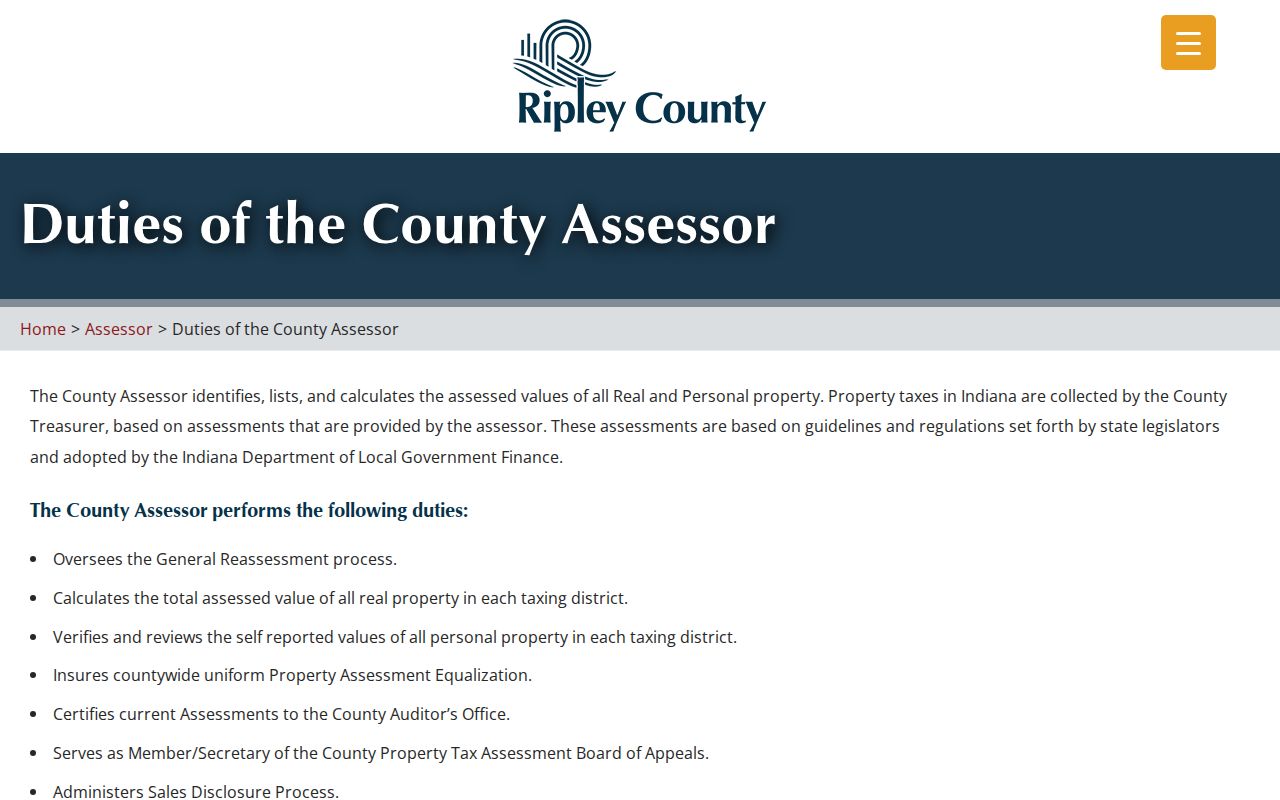
One point of confusion is worth clearing up. Assessment, sales disclosures, exemption administration, and PTABOA work all belong to the Assessor's office. The Treasurer's desk handles payments, not valuations.
Look Up Ripley Tax Bills
The Ripley County Treasurer links to Low Tax Info for live property-tax lookup. Because that vendor is county-linked, its search controls and coverage can shift over time. Treat the official Treasurer page as your doorway, and confirm a live balance before paying anything.
- Find the parcel in the county GIS by address, owner, or parcel number. Copy the identifier exactly.
- Open the tax lookup from the Treasurer's official page and search the parcel. Check the bill year and installment.
- Compare the assessed and net assessed values with the Assessor record. Note any deduction shown.
- Check payment or delinquency status. Contact the Treasurer when the web display and a receipt or notice disagree.
- Assessed value
- The official value assigned under Indiana assessment rules before the tax calculation.
- Market value-in-use
- Indiana's value concept based on a property's current use and market evidence.
- Tax rate or levy
- The certified local rate and revenue amount used in tax calculations.
- Homestead deduction
- Qualified relief for an eligible principal residence, obtained through the official filing process.
- Tax lien
- A legal claim arising from unpaid property tax; it is not the same as a transfer of title.
Save the result date and confirmation number with any payment you make. A static screen never proves a later balance.
Ripley Tax Bill Calendar
The county's tax-bill instructions describe one bill mailed in spring for the full year. It splits into spring and fall A/B portions. For 2026, the posted due dates are May 11 and November 10. A mailed payment must carry a postmark by the deadline. Taxpayers who want a receipt by mail should follow the county's return-envelope instructions.
Late penalties are steep. The posted schedule adds 5% from the day after the due date through 29 days late. It then adds 10% at 30 days or more. Online credit, debit, PayPal, and Venmo payments carry a 3.15% fee with a $2 minimum. ACH costs $1.50. Verify dates, fees, and balances before you pay.
Hang onto the spring bill, since it also carries the fall installment. For mail, write the parcel reference on the payment and use the Treasurer's posted P.O. Box 176 address only after checking current instructions. Online, review the convenience charge before submitting and save the receipt. A returned payment, an unapplied payment, or a balance that changed after an adjustment belongs with the Treasurer at 812-689-6352. Staff can pull the right account record. Give them the tax year and parcel number.
Note: The county mails one annual statement. Keep the fall portion even after the spring amount is paid.
Ripley Assessment and Trending
The Indiana Department of Local Government Finance explains the 100% ratio. It also covers the market-value-in-use system behind it. Assessors study prior-year sales of similar property. They apply annual adjustments, a practice often called trending. That differs from a private appraisal prepared for one sale or loan.
Ripley's DLGF county page publishes certified rates and levies. Budget orders, ratio studies for 2022 through 2026, approval letters, narratives, and land orders appear there too. These files explain countywide methods and district rates. They do not replace your parcel's notice or bill.
The state material supplies the certified context you need. Use it to test a rate or trend claim against official property records.
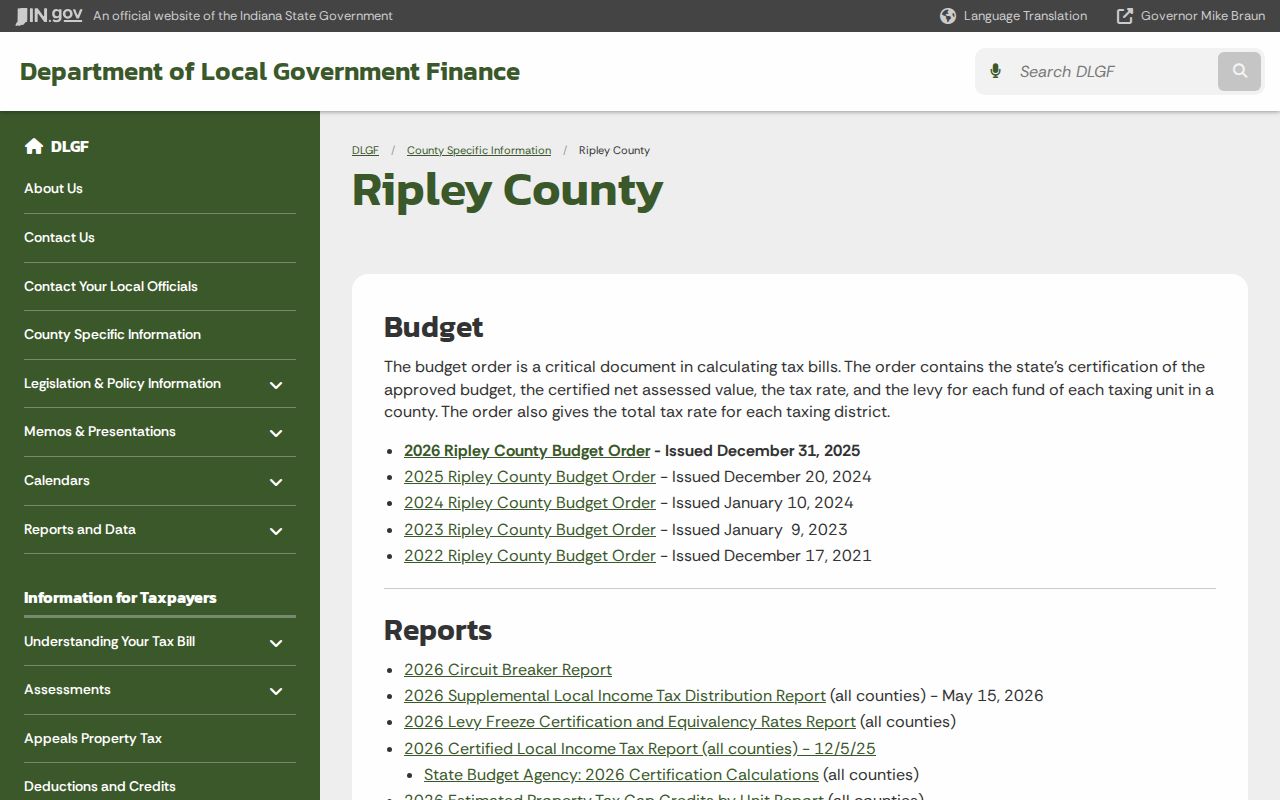
The state page supplies certified figures and study data. Use those to check any rate or trending claim against official records.
Ripley Reassessment Starts in 2026
Indiana's next statewide cyclical reassessment starts July 1, 2026 for 2026 Pay 2027 taxes. Roughly one quarter of parcels get a physical inspection each year of the four-year cycle. Inspectors verify facts such as square footage and acreage. Annual trending still tracks the market in between.
This timing can leave several values in view at once: a prior certified value, the current bill's value, and a work-in-progress figure on a property card. Write the label and year beside each number you record. If a displayed value affects an appeal or payment choice, ask the Assessor whether it has been certified.
Ripley Tax Deductions and Caps
Indiana's DLGF deductions and credits page lays out the main relief programs. These apply to a Ripley County tax bill. Homestead, mortgage, age, disability, and veteran deductions all sit there. Each carries its own eligibility test. One rule matters most. The Department of Local Government Finance says deductions generally must be reapplied for after a sale or a change in title. A prior owner's tax treatment should never be assumed to carry forward onto a new deed.
The official forms are specific. State Form 51781 covers the general application. HC10 homestead Form 05473, mortgage Form 43709, over-65 Form 43708, blind or disabled Form 43710, and disabled-veteran Form 12662 each serve its own program. File through the proper Ripley County route and keep proof of filing. Indiana also groups its tax caps into 1%, 2%, and 3% categories. A cap is not a deduction, though. It does not erase every charge on the bill.
A deed transfer can quietly change which relief applies to the parcel. Compare the grantee and transfer date from the recorded deed against the deduction record. Then ask the Auditor whether a new filing is required. Eligibility never follows from an address alone or from a prior bill. The official form plus county review decide whether a Ripley County deduction or credit is allowed.
Ripley Delinquency and Tax Sale
The Treasurer's office links to SRI Services for Ripley County tax-sale information. A delinquent account moves through notice, sale, and redemption stages. Indiana law governs this process, including IC 6-1.1-24. The live stage matters. A certificate holder or tax-sale purchaser is not always the current fee owner of record.
Reconcile the Treasurer or SRI listing against the Recorder's later tax deed or a related instrument. Also check any public court case. If dates or names conflict, keep each source. Ask the custodian about the true status. A tax-sale list is no shortcut to ownership.
For a written inquiry, supply the parcel number and the owner name as shown on the record. Include the tax year, the bill installment, and the exact balance or sale-status question. Request an existing public record rather than a legal conclusion. Indiana's Access to Public Records Act, IC 5-14-3, supports inspection. It also supports copying of identifiable public records. It does not force an office to build a custom tax analysis.
Appeal a Ripley Tax Assessment
A Ripley County assessment appeal contests the value. The tax rate and late payments are not contested. Indiana guidance generally allows 45 days from a Form 11 notice, or the later applicable tax-bill notice date. The appeal uses Form 130. The notice controls. Confirm the form and the exact deadline with the county Auditor or Assessor before filing. A payment problem belongs with the Treasurer. A deduction filing may involve the Auditor instead.
Build the case from the parcel card and the assessment notice. Add the property's facts and relevant sales. A factual error such as wrong acreage or improvement detail can anchor the appeal. Otherwise, explain why comparable sales fail to support the assigned market value-in-use. The Assessor serves on the Property Tax Assessment Board of Appeals, known as PTABOA. Keep a date-stamped copy of the filing and every exhibit.
Appeal window. Follow the deadline printed on the current Ripley County notice. The general 45-day framework does not override the date that governs a specific assessment.
For a focused explanation of how assessed value differs from sale price, see the Ripley County property value resource. Ownership questions call for the latest recorded deed, not the tax card.