
Locate Milan Property Records
Milan property records live at the Ripley County level, not with a town recorder or assessor. Begin with the county map and parcel card. Then turn to Milan's code and council meeting files when a land-use, street, utility, or project question needs the town's own rules.
- Search the Milan address or owner in Ripley GIS.
- Save parcel, situs, legal, and transfer fields.
- Confirm conveyances through Recorder instruments.
- Check assessor value and Treasurer tax sources.
- Search Milan code, minutes, and county permit files.
The county search form also lets you filter owner records by neighborhood, class, acreage, dates, and price. The Ripley County property search walks through those mechanics in detail. Return to Milan sources afterward for the town-level lens.
Milan Property Record Sources
Ripley County offices hold the legal land and tax trail. The Recorder preserves deeds and other instruments. The Assessor and GIS office show parcels and value. The Treasurer manages tax accounts, and county planning keeps the confirmed permit route. Milan Town Hall maintains town records and points visitors to its current code and resources.
Ripley County land records
County systems carry deeds, parcel cards, assessments, taxes, and permit files.
Milan Land Usage Records
American Legal Publishing hosts the online Milan code. The edition runs current through Ordinance 12092024-1, 2025 S-5, and Title XV covers Land Usage. Its own disclaimer urges readers to consult the latest official printed copy. Record the edition date beside any section you cite.
Read the town code alongside Ripley County Chapter 80 and the APC files. Minutes prove an issue was discussed. An ordinance states a town rule. The APC may hold the permit or site plan, while the Recorder holds any deed, plat, easement, or restriction. No single source substitutes for the other three.
Milan Permit Request Fields
Milan publishes no searchable permit-history database or complete online zoning map. Ask staff with enough detail that they can tell a town file from a county file.
| Search detail | Use |
|---|---|
| Street address and parcel | Connects town and county systems |
| Project and date range | Narrows permits, inspections, or minutes |
| Legal description | Separates tracts with an old name |
| Ordinance or agenda term | Finds the municipal action |
County rules require permits for structures or improvements of at least 144 square feet. The process calls for detailed plans, a posted address and permit, inspections, and an application number. Confirm the current rule and ask whether Milan keeps a companion municipal record.
Milan Places in Property Records
Official sources supply no three verified Milan subdivision names. Treat these historically documented areas and property anchors as search leads rather than plat labels. When populated, the parcel card's own subdivision and lot fields control.
| Neighborhood / Subdivision | Era | In the Records |
|---|---|---|
| Harding's Store area | Post office established 1837 | Historic name requires deed and address cross-check |
| Old Milan crossroads | Early settlement era | Use as a locality clue, not a platted subdivision |
| Former State Bank | Museum opened 2013 | Named-building lead for current parcel research |
Search a known address or owner in GIS first. If the subdivision field is blank, keep the township, section or tract, street, legal text, and nearby parcel clues. The Ripley County parcel maps material explains why a postal locality is not a boundary.
Old Milan Address Clues
The official history places settlement in the 1820s and 1830s. The post office opened at Harding's Store in 1837. Milan adopted its name in 1842. The history also describes German and Swiss grape culture, wine production, and an 1868 business listing.
Historic records may name a store, crossroads, business, owner, or railroad instead of a street number. Preserve that wording. Search names and legal descriptions rather than guessing a modern parcel from proximity alone.
The official Milan history page supplies those local identity clues for record searches.
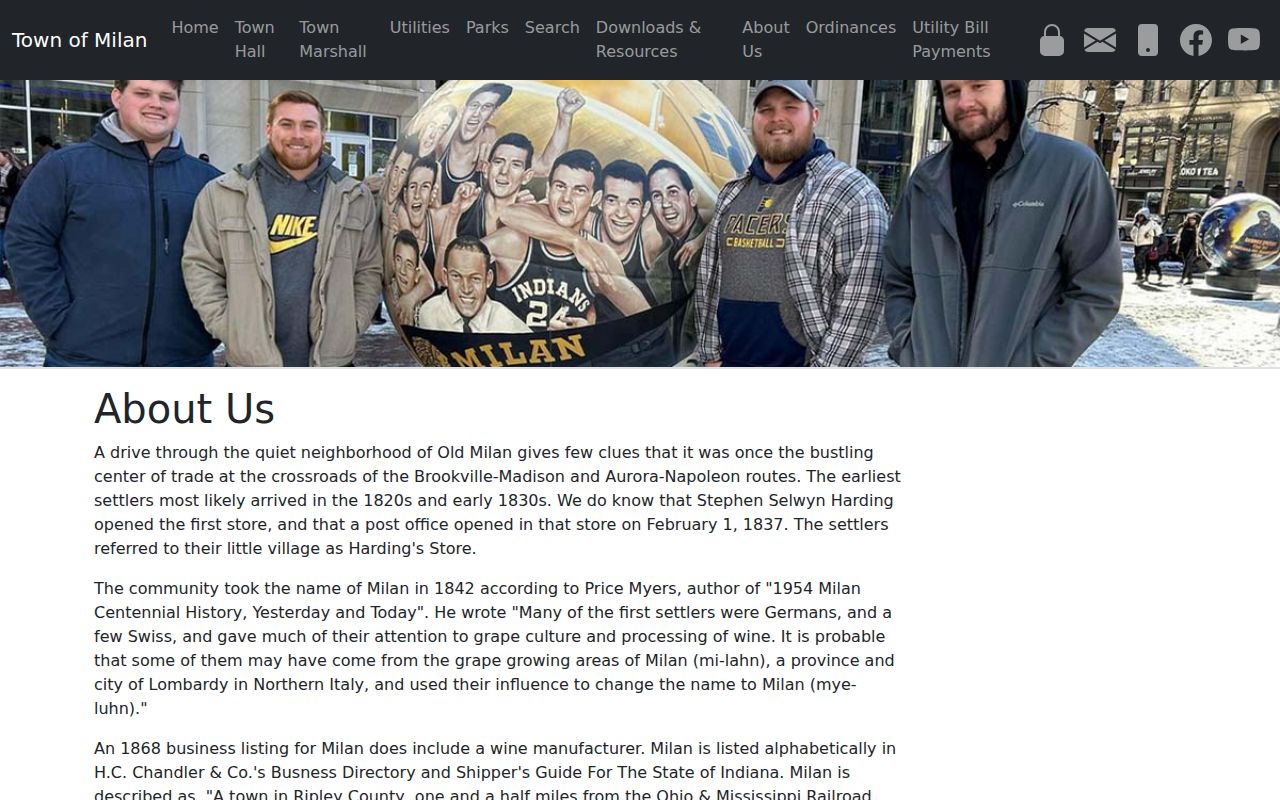
The municipal history adds context, while present ownership still comes from the county parcel card and the latest deed.
Milan Railroad Property Context
The town history places the Ohio and Mississippi Railroad about one and a half miles away. That distance helps explain why old commercial references may not align with current street geography. The Old Milan crossroads story adds to the confusion.
A railroad clue can lead to deeds, plats, rights-of-way, leases, or utility records. Still, the history proves no present boundary. Search the exact historic name first. Then connect it to a county parcel and legal description.
Milan ZIP and Town Limits
Milan 47031 is a postal convention. USPS can confirm an exact delivery address but not town limits, ownership, or occupancy. The GIS card separately shows township, district, school corporation, neighborhood, zoning, subdivision, and lot.
Keep postal city and municipal jurisdiction as separate fields. If a code or permit question turns on location, ask Milan and county planning which file applies rather than assuming from the ZIP.
Milan Record Request Worksheet
Preserve the modern address, any historic business or place name, county parcel number, owner display, township, district, legal description, subdivision or lot if shown, transfer document, and source date. Those fields let you trace the same property through live and archival sources.
- Ask the Recorder for relevant deeds, plats, easements, or restrictions.
- Ask APC for permit, site plan, inspection, variance, or occupancy files.
- Ask Milan for minutes, ordinances, forms, streets, and utility actions.
- Use the legal description when the old place name has no number.
Use the dated assessment fields for a current value. Historical town accounts and council records add background, but the county's own assessment data is what carries the numbers.
Milan Historic Bank Evidence
The Milan '54 Hoosiers museum sits in the building that once housed the State Bank. Its official history dates the opening to June 2013. That one address teaches how record roles differ. A history source names the institution and its use. GIS maps the current parcel. The Ripley County Recorder holds the deed that carries title evidence.
Hold off on any claim about present ownership until the live parcel card and the recorded deed agree. A named building can span a redrawn parcel, a changed street number, or a new use over time. Note the date of each source. Keep the exact name each one displays.
Reconcile Milan Record Dates
Dates drive every Milan property search. The GIS and assessment displays are live views. The online Milan code states its own ordinance currency point. It points to the printed copy as official. Council minutes carry meeting dates. A deed shows a recording date. The transfer itself may carry an earlier execution date. Set each date beside its source instead of treating every record as equally current.
A simple worksheet earns its keep. Record the address, ZIP, parcel and parent parcel numbers, and the owner display. Add the township, district, neighborhood, zoning, legal description, and acreage. Include the subdivision and lot when populated, plus the transfer document, value year, and the date you pulled the data. Add Harding's Store, Old Milan, the railroad, the wine business, or the former State Bank only as historic identity clues. The town history supports those.
Land-use questions deserve their own routine. Quote the relevant Title XV term and the code edition. Then chase the later ordinance or official copy when currency matters. Ask the county APC for the address and parcel file. It can include permits, site plans, inspections, occupancy certificates, variances, exceptions, appeals, flood reviews, complaints, and plats. Search Town Hall resources and minutes for related town action. The Recorder supplies the deed, easement, restriction, or recorded plat.
Stop when the old and new identities cannot be joined. A historic crossroads description may cover more ground than one modern parcel. Railroad distance is context, never a boundary call. A blank subdivision field does not justify an invented neighborhood. Those limits make Milan property records stronger, because every asserted link stays traceable to its source.
Milan Ownership Across Eras
A Milan history can name a store, bank, railroad business, wine producer, or family. It does not prove who owns the land today. Start with the exact wording and its date. Search that name in the Ripley County Recorder indexes. Then compare the legal description you find against the current parcel card. If the street identity has shifted, lean on township, tract, acreage, neighboring owners, and recorded references. That narrows the land.
For a current owner, the assessor display is the first clue. The latest deed is the stronger confirmation. Copy trust, estate, company, and multiple-owner names exactly as written. Check the transfer date and document identifier. A mailing address may sit outside Milan, and one owner can hold several parcels. Neither fact changes the situs.
Former ownership calls for a backward chain. Begin with the current deed's grantor. Find the instrument by which that grantor acquired the land, then repeat the step. The Recorder's public computers serve as the fallback. Staff do not run searches for visitors. Older deed books and IARA microfilm extend the trail where online results stop.
Value records need dates too. Read the land, improvement, and total fields from the same assessment year. Include the reason for change and the status. A former commercial use or a town-history account may point you toward useful records. It cannot set current value. Keep history, ownership, and assessment in separate columns. Milan property records stay accurate across eras.
Milan Property Record Limits
Milan property records can establish assessed ownership, transfers, value, parcel context, land-use rules, permits, and town actions. They cannot, on their own, prove surveyed boundaries, clear title, occupancy, current market price, or that a discussed project was adopted.
Verify consequential facts with the custodian. Respect confidential addresses and skip needless personal details.
Lawful use. Milan property records support land research, purchase review, house history, and civic transparency. They are not a title search and must never be used to harass or harm.