
Ripley County Value Types
A county card can carry several numbers, and each answers a different question. Indiana assessors use market value-in-use. That means the worth of a property for its current use. It applies under the state's assessment framework. The card then splits assessed amounts into land, improvements, and a total. Transfer fields may hold a sale price tied to a deed. A private appraisal sits apart from all of these.
| Value | What It Is | Where |
|---|---|---|
| Assessed value | Land, improvements, and total used in assessment administration | Assessor parcel card |
| Market value-in-use | Indiana's standard for property in its current use | Assessment framework and county record |
| Last sale price | Consideration shown for a prior transfer, when reported | Transfer section, deed, or sales disclosure |
| Private appraisal | A dated professional opinion for a stated purpose | Not a county parcel-card field |
These figures can disagree without anything being wrong. Some sales carry odd terms, multiple parcels, personal property, or a non-market transfer. The assessment year may also lag the sale date. Indiana's ratio studies compare assessments with sales to gauge how well assessments track across groups of properties, rather than forcing every sale to become the next assessed value.
Inside Ripley Assessment Cards
The county's agricultural parcel cards run three pages. The valuation section lists assessment year, reason for change, as-of date, method, equalization factor, notice status, and land, improvement, and total categories. Land details can go further, showing type, pricing method, soil ID, frontage, size, factor, rate, adjusted rate, inflation percentage, residential eligibility percentage, market factor, and market value.
That inventory matters. One total hides how the assessor reached it, so compare like years and categories. A higher total might trace to land, a building change, annual trending, equalization, or corrected acreage. Work-in-progress values carry an uncertified label and remain subject to change.
The DLGF Ripley County page publishes county ratio studies, narratives, budget orders, tax rates and levies, and land orders.
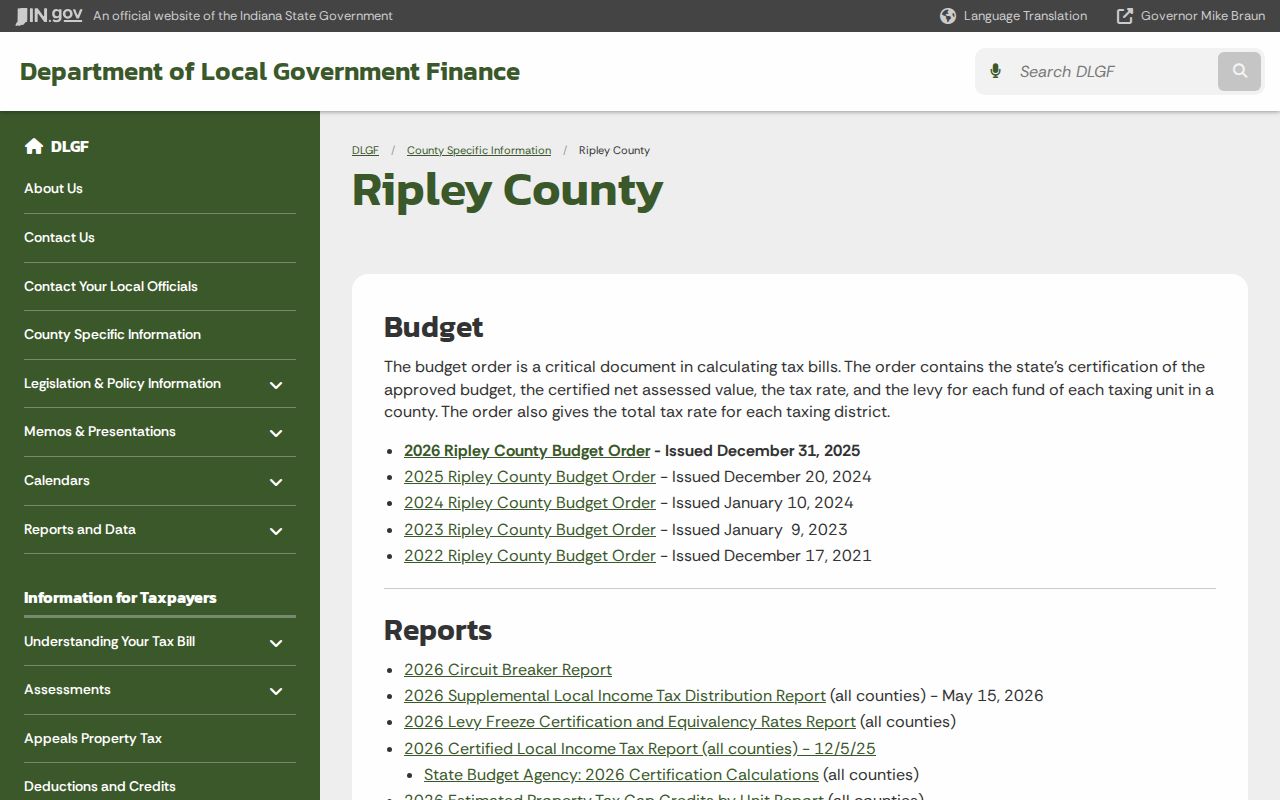
The state source supplies the county-level context that helps a reader place a parcel value alongside the assessment system used to produce it.
Ripley Values Change Each Year
Ripley County keeps assessments current through annual adjustments, a process Indiana calls trending. Between physical reviews, these yearly moves nudge values toward market value-in-use. The DLGF checks the local work and publishes ratio studies along with county narratives. A cyclical reassessment period starts July 1, 2026. It layers planned physical inspections onto the annual data cycle.
A changed figure does not mean your tax bill rises automatically. It also does not prove a recent sale. Read the assessment year and the as-of date. Check the reason-for-change field too. See whether the amount is certified. Then compare the property characteristics driving the value. The formal notice and the assessor record beat any old screenshot.
Find a Ripley Property Value
Start on the official Ripley County GIS map. Identify the parcel, then open its property record card. Search by exact address first. If that comes up empty, try an owner surname or parcel number. You can also search by neighborhood, property class, acreage, or the custom form's sale filters. Record the source date, since live assessment data can change.
- Search the address or parcel in Ripley GIS.
- Open the card and record the assessment year and status.
- Separate land, improvement, and total amounts.
- Read the transfer date and sale amount when present.
- Check the deed or state sales disclosure before relying on that price.
- Assessed value
- The official value entered for assessment administration.
- Market value-in-use
- Indiana's value standard based on the property's current use.
- Assessment ratio
- A comparison of assessments to sale prices across tested properties.
- Reassessment
- The scheduled review of property data and value.
Ripley Sale Prices Need Context
On a parcel card, the Transfer of Ownership area may list a date, owner, document ID, code, book and page, and sale price. The Assessor keeps sales information from 1999 forward. Indiana's public sales-disclosure search reaches disclosures filed after July 1, 2008. Each source helps, but a displayed price still needs its transfer context behind it.
Check whether the deed covers one parcel or several. Ask if the transaction looks arm's length. A quitclaim, estate transfer, family conveyance, correction, or nominal consideration may not measure open-market value. The Recorder holds the instrument itself. The assessor card just summarizes the fields.
Land and Improvements in Ripley
Splitting land from improvements often explains a change. A vacant parcel may carry land value only. A farm card can include soil, acreage, pricing, and eligibility details, while a developed property adds building computations and construction characteristics where applicable.
Never add land and building figures from different years. Watch for parent-parcel or split clues too. A survey, combination, new structure, demolition, or corrected classification can shift the parts without any normal market sale. The reason-for-change and as-of fields on the parcel record are the key evidence.
Ripley Value and Tax Differ
Assessed value feeds the tax system; it is not the bill. Deductions, credits, exemptions, and local rates all shape the final amount due. Constitutional caps and other calculations matter too. A lower bill does not prove a lower market value-in-use. A higher assessment alone does not reveal the tax owed.
The Ripley County property tax record material covers bills, payment, deductions, and appeals. Keep the comparison centered on what each figure means and where its record lives.
Correcting a Ripley Value Record
Start by sorting out what kind of problem you have. Is it the value itself? Maybe it is a factual error on the property card, or just a glitch in the GIS display. Pull the current card. Set it aside with the date noted. Then compare its acreage, property class, buildings, land breakdown, transfer history, and legal description against the deed and the survey. A mismatch in that paperwork points you toward the right fix.
Valuation and sales information belong to the Assessor. PTABOA handles the next step in a review. Whatever you file, cite the parcel number. Also list the assessment year, the field being challenged, and the record that supports you. Treat any shifting work-in-progress figure as provisional rather than final.
Compare Ripley Values Fairly
Start any comparison on level ground. Match the assessment year and the property use before you weigh two numbers against each other. The Basic Parcels search lets you filter by neighborhood, property class, acreage, sale date, and sale price. Those filters help you build a candidate list. They do not produce an appraisal. Read the resulting cards for land type, improvements, parcel size, transfer code, and the as-of date. Remember that a farm, a vacant tract, and an improved home are not interchangeable just because they share a ZIP code.
Sale dates deserve equal care. The county Assessor keeps sales information from 1999 forward. The state sales-disclosure search covers public records after July 1, 2008. An older deed may still state consideration or cite a book and page. The modern online route may simply not reach it. When the online span runs short, fall back on the Recorder's public computers and the deed books.
Tracking a trend takes discipline. Keep one row per year with land value, improvement value, total, reason for change, as-of date, and certification status. The sample agricultural card rises across several years. Yet the Assessor's own materials caution that one sample is not a county market trend. They label work-in-progress amounts as subject to change. Never stretch that single card into a claim about Versailles, Milan, Osgood, or Ripley County as a whole.
Different questions call for different evidence. A purchase review might weigh recent arm's-length transfers against a private appraisal. An assessment review leans on the official card, the notice, property facts, ratio materials, and comparable classification. An estate history may need the deed and the value as of an earlier date. Name the question first. That habit keeps the right Ripley County property value from being mistaken for a different number.
Ripley Property Value Limits
A county assessment is a mass-appraisal result built for the public tax system. It is not a promise of sale price. It is also not a title opinion, a survey, or a private appraisal. Even the last recorded price only describes a past transfer on its own terms. Present condition, market date, rights conveyed, and transaction conditions can all differ. For a professional opinion tied to a current purpose, use a licensed appraiser. Bring in a title professional or attorney for title questions and a surveyor for boundaries. County records still earn their keep. They make the year, the parcel, the assessed categories, and the transfer trail visible at a glance.
Value is not price. A Ripley County assessed value supports taxation and is not a forecast of what the property would sell for or a private appraisal.