
Search Ripley County Property Records
Start any search with the record that pins down the land itself. The Ripley County GIS viewer takes an address, an owner, a state parcel number, or a county parcel number. Once a parcel card appears, it can tie a street address to the assessment owner. It also links the legal description, the taxing district, acreage, recent transfer rows, and assessed values. That makes GIS the natural first stop. Keep in mind it is a finding tool. It is not the final word on title, boundaries, or taxes.
Bring the parcel number and legal description into every search that follows. A name alone invites false matches, especially with trusts, estates, businesses, or shared surnames. Dates deserve care too. A sale date, a deed recording date, an assessment year, a tax payable year, a permit date, and a court filing date each describe a different event.
- Find the parcel by exact address, owner, or parcel number in GIS.
- Save the owner display, legal description, parcel number, and transfer document ID.
- Use those identifiers at the Recorder to inspect the deed and related instruments.
- Check the Assessor and Treasurer sources for value, deductions, bills, and payment status.
- Ask Area Planning, the Clerk, or an archive for permits, court files, or older material.
Where Ripley County Keeps Property Records
Most routine land questions land at three offices in the county Annex. The Recorder keeps deeds, mortgages, liens, leases, plats, and other instruments that affect title. The Assessor finds and values parcels, and the office holds sale information from 1999 forward. The Treasurer collects the tax built on those assessments. The office also connects taxpayers to the county tax lookup and tax-sale vendor. All three offices post weekday hours of 8 a.m. to 4 p.m. Verify hours before you go.
Ripley County Recorder
102 West First North Street
Versailles, IN 47042
812-689-5808
Ripley County Assessor
102 West First North Street
Versailles, IN 47042
812-689-5656
Ripley County Treasurer
102 West First North Street
Versailles, IN 47042
812-689-6352
Each office uses its own mailing box. Check the department's official page before you send anything. The strongest request names a record series. It should also give a parcel or party, a date range, and the format you want. Indiana's Access to Public Records Act, IC 5-14-3, governs inspection and copying of existing public records. The Act does not obligate staff to run a title search. It also does not require them to build a new report.
Ripley GIS Search Fields
The live county viewer offers one broad search box plus a Basic Parcels form. That form accepts a last name, with a first name as an option. Under the hood, the search choices also cover address, state parcel, county parcel, and sales criteria. A narrow, exact query beats a sprawling owner-name result every time.
| Search Key | Best Use | Check Before Selecting |
|---|---|---|
| Street address | Locate a known site | Directional, suffix, postal city, and unit |
| Owner name | Find parcels tied to a person or entity | First name, trust or company wording, and mailing address |
| County or state parcel | Match a known tax or deed reference | Punctuation, leading zeroes, and parent parcel |
| Sales filters | Narrow transfers by date, price, class, area, or acreage | Whether the row is a qualified sale and which year applies |
A rural mailing city can mislead you about jurisdiction. One county card pairs a Batesville postal address with Delaware Township, a reminder that mail and government lines differ. The card also carries district, school corporation, and neighborhood fields. Those separate labels explain why the parcel number should stay the cross-system key. The official county GIS page shows the source and its warning before the viewer opens.
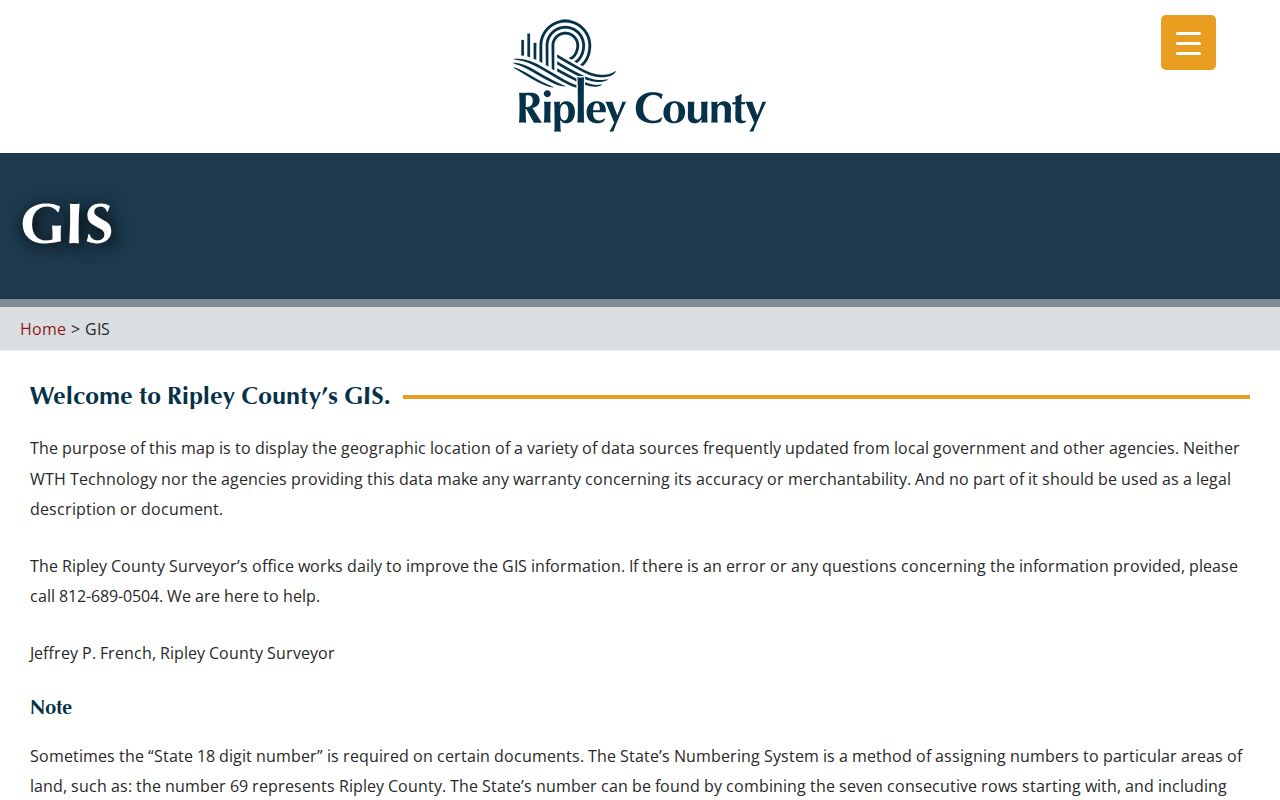
The county calls its geographic data frequently updated, and it disclaims any use as a legal description or survey. So treat a highlighted parcel as orientation only. Then read the deed, plat, or survey itself.
Ripley County Property Record Types
No single database tells the whole property story. A GIS result may flag the right tract. Only a recorded instrument shows the text of a transfer or easement, though. An assessment explains the value behind tax work, but it is not the Treasurer's bill. A planning file can prove work was approved without deciding who owns the land.
| County Record | Question It Helps Answer | Custodian | Practical Access |
|---|---|---|---|
| Deed, mortgage, lien, release | What land instrument was recorded and by whom? | Recorder | Office public computer, inspection, or copy request |
| Parcel and assessment card | Which parcel, owner display, class, and value appear now? | Assessor | GIS viewer, office, phone, or records request |
| Tax bill and payment status | What was billed, paid, or sent toward tax sale? | Treasurer | County-linked lookup, office, mail, or phone |
| Plat, parcel map, survey reference | How is a lot or tract described and mapped? | Recorder, APC, Surveyor | GIS for orientation; recorded files for proof |
| Permit, zoning, variance, occupancy | What land use or construction action was reviewed? | Area Planning and Building | Office inquiry, application file, meeting record, or APRA request |
| Foreclosure, quiet title, probate | Was a property-related dispute or estate filed? | Clerk and courts | MyCase, Clerk file, Historical Society, or IARA |
A parcel audit often needs two or three rows from the table. Purchase due diligence might join the latest deed, recorded releases, current tax status, GIS identity, and permit history. Boundary work adds the recorded plat and survey. Older ownership can reach far past the live systems.
Reading a Ripley Parcel Card
A Ripley County parcel card packs in a lot. Its general section can hold county and state parcel numbers, a parent parcel, tax routing details, property class, category, and agricultural status. Location fields may list township, local district, school corporation, neighborhood, situs, zoning, subdivision, and lot. Blank zoning or subdivision fields prove nothing about whether a regulation or plat exists.
A parcel is a unit tracked for assessment. A plat is a recorded map of lots or land divisions. The situs is the location address of the property. Assessed value drives Indiana's tax system; it is not an appraisal of a likely sale price.
The ownership block lists the assessment owner and a mailing address. In the legal block you may find section, quarter, tract, acreage, or survey language. Transfer rows show several data points. You can see the date, owner, document ID, code, book and page, and sale price. A placeholder date or a zero price is not a normal market sale. Follow the linked record route and read the instrument itself.
Valuation fields can also be marked as work in progress and not certified. Keep the assessment year and as-of date with any number. The Assessor's duty page confirms the office maintains sales information from 1999 to the present. State DLGF sales disclosures give a separate public source for sales after July 1, 2008.
Ripley County Deeds Need Context
Ripley County indexes deeds by party and instrument. A street address alone will not carry the search. A grantor conveys an interest. A grantee takes one. Mortgages appear under mortgagor and mortgagee names alike. Follow both sides of any ownership chain, and hold onto the legal description as names and parcel numbers shift over time.
Recorder staff will not search records for a requester or give legal opinions. Bring a document number or book and page. Staff can then pull the copy. Without recording details, the fallback is an in-person search at the office's public-access computers. The Ripley County Recorder publishes no online image portal and sets no historic cutoff for internet records.
Copies up to 11 by 17 inches cost $1 per page. Certification runs $5. The county warns that commercial deed-copy mailers may charge far more for a document that costs about $2 straight from the office. Compare any solicitation against the Recorder's current fee page and call the office before paying.
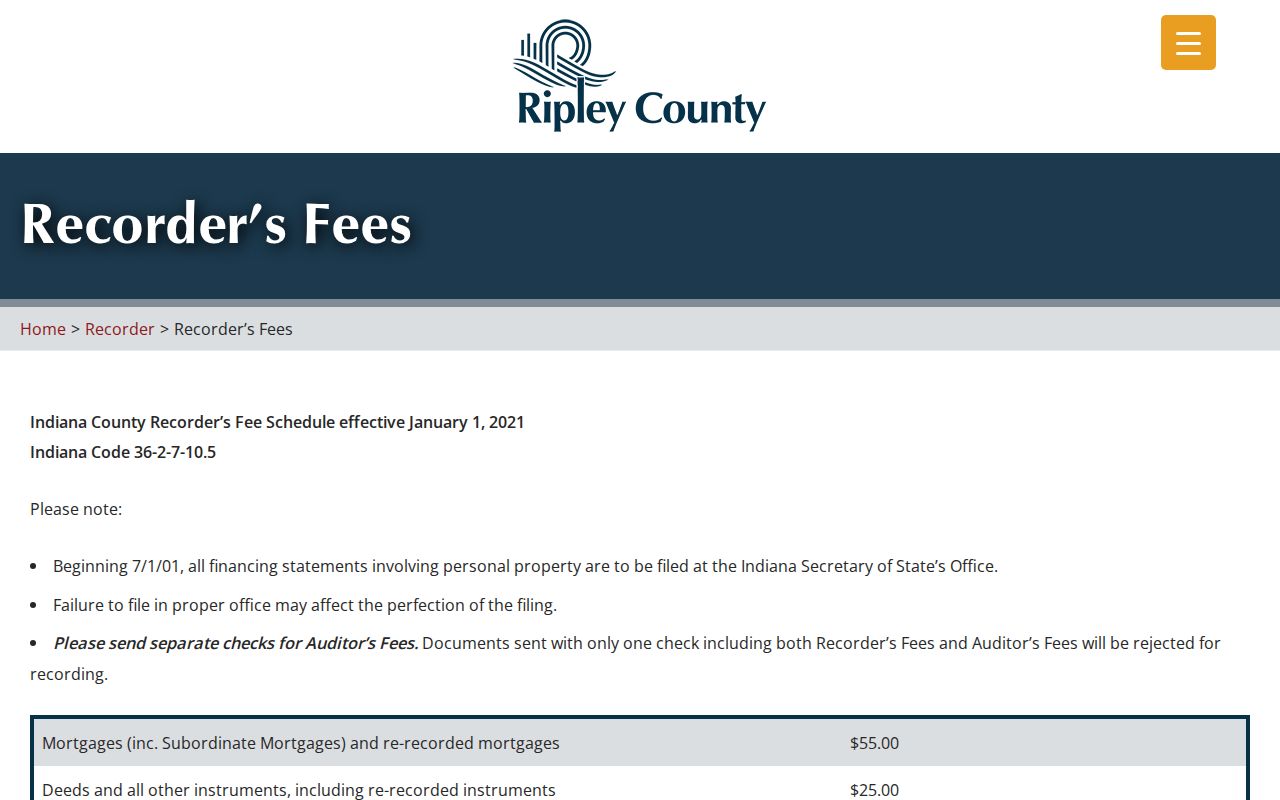
The posted schedule separates copying from recording. Ordering a copy of an existing Ripley County deed is a different transaction from recording a new instrument at the Recorder's office.
Ripley Assessments and Tax Records
Ripley County's Assessor and Treasurer keep related but distinct property records. The Assessor identifies property, lists it, and calculates assessed values. That office also oversees reassessment, maintains sales disclosures, and helps administer deductions. The Treasurer collects taxes based on the assessment. The Auditor handles transfer and tax accounting and applies deductions. Ask whichever office owns the function behind your question.
Indiana uses market value-in-use at a 100 percent ratio. Annual trending leans on comparable sales. Cyclical reassessment involves physical review. The next statewide cycle starts July 1, 2026 for taxes payable in 2027, with roughly a quarter of parcels inspected each year across four years. A work-in-progress GIS value can still shift before certification.
The Treasurer's page links Low Tax Info for lookup. It also links SRI Services for tax-sale information. Vendor fields and balances change, so reach them through the county page and confirm any result with the Treasurer. One annual bill arrives by mail with spring and fall portions, so check due dates, late penalties, and payment fees for the year at hand rather than an old notice.
Ripley Permits Follow the Parcel
Permits in Ripley County follow the parcel. Area Planning and Building keeps a separate trail for land use and improvements. The county requires an Improvement Location Permit whenever a structure, improvement, or use is placed or altered on platted or unplatted land. Site plans can get detailed. They may list the address, legal or site description, acreage, buildings, roads, entrances, lot shape, setbacks, septic sites, and recorded survey or deed information.
The threshold is 144 square feet. Plans are required too. So are a posted job-site address and permit, staged inspections, and a permanent 911 address and driveway culvert by final inspection. That 911 detail explains a common mismatch. A new situs may not match the location wording in an older deed.
No Versailles, Milan, or Osgood permit portal exists online. Town minutes and codes still yield clues about roads, utilities, zoning, and plans. County Area Planning is the confirmed permit route. When you request a file, supply the exact address, parcel number, project type, municipality, and date range.
Ripley Property Cases in MyCase
Foreclosure, quiet-title, probate, lien-enforcement, and tax-sale disputes can surface in Indiana's MyCase system. It searches by case, name, or attorney. Court, case status, and filing-date filters narrow the results. Spelling of party names matters. Search current and prior owners, lenders, trustees, estates, and business names separately, because a case caption may not match the assessment owner display.
MyCase is not the official court record. It skips some courts, documents, and older files, and it caps results at 1,000. A missing result does not prove absence. For a complete or certified county file, use the case number to contact the Ripley County Clerk at the Courthouse, 115 N Main Street in Versailles, 812-689-6115.
Federal bankruptcy or foreclosure litigation runs through PACER instead. A separate problem hides in the Recorder's books, since a recorded lien can exist with no matching lawsuit. Court searches therefore must be compared against Recorder instruments. Only that side-by-side comparison shows whether a Ripley County property carries liens.
Older Ripley Property Records Split
Ripley County dates to 1816. It was organized in 1818. The Indiana Archives and Records Administration inventory lists deed volumes from 1818 through 1886, and deed index series beginning in 1818 that reach into the late nineteenth century. Old entries rarely give a street address. Land was described by town lot, section, quarter, tract, survey, acreage, or a neighboring owner's name. That vocabulary matters when you follow a parcel forward.
The Clerk adds one local twist. Records dated before 1965 are directed to the Ripley County Historical Society building, whose county-published phone is 812-689-3031. Call before visiting, since the society posts no holdings list, schedule, or copy policy. IARA stays the source for state-held microfilm and archival series, including probate books from 1834 plus court, marriage, naturalization, and vital records.
IARA also lists 1875 maps of Jennings and Ripley counties that show residences in each township and tie owner names or old roads to present geography. Treat them as leads, not surveys. Osgood Public Library's Indiana Room adds newspapers, family histories, cemetery references, and local notes. Tyson Library and the Historical Society hold different collections. The deed or official court record still settles ownership.
Ripley Recorder Fraud Alerts
The Recorder offers two property-fraud tools. Doxpop Property Watch sends a free notice when a document matching criteria such as a name or legal description enters the Ripley Recorder system. Equity Protect supplies a free report with a risk level. Paid monitoring is optional afterward. Neither alert nor score is proof.
Coverage and matching details are not on the county page. Check account steps and current terms before relying on an alert. Monitoring helps. It does not replace periodic review of the parcel card and recorded instruments. Take a suspected false filing to the Recorder and qualified legal counsel. The county's property-fraud mitigation page is the official local source for both offerings.
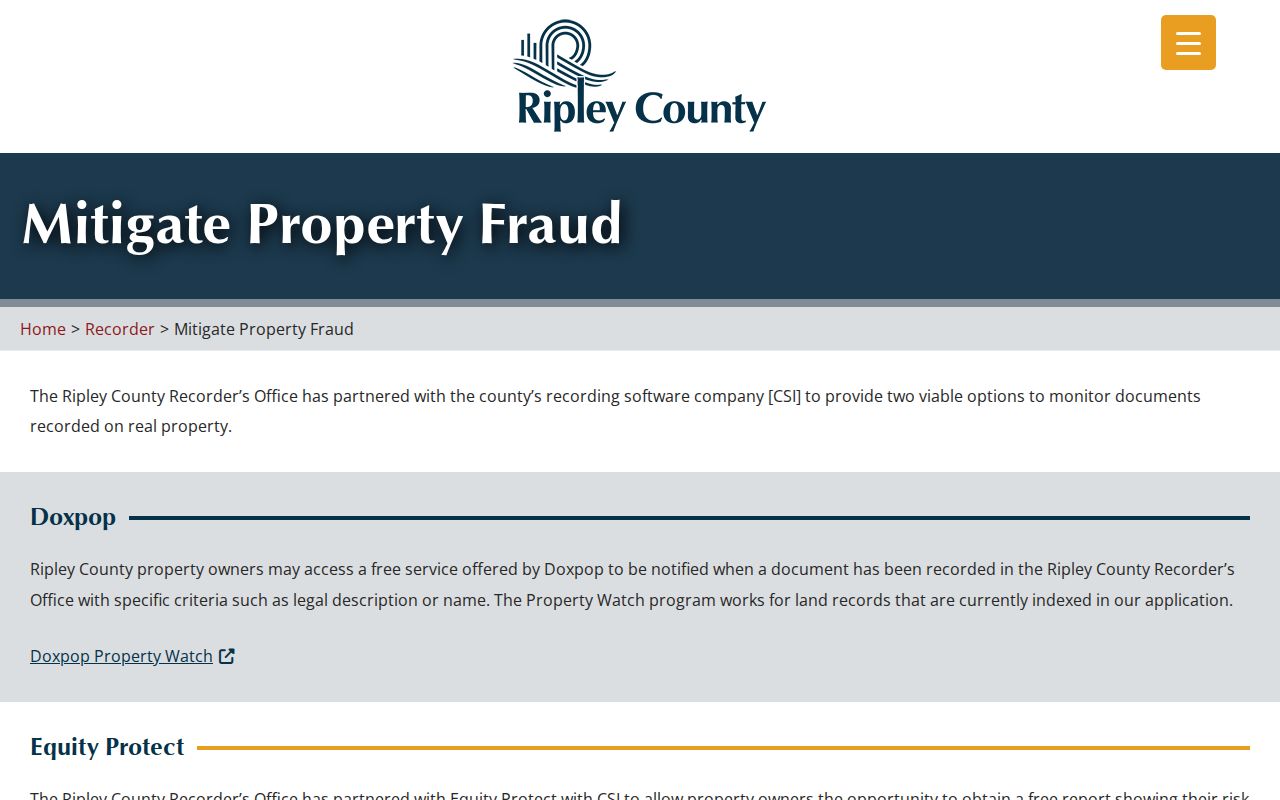
A recording notice and a risk report work differently, as the program page explains. Both remain alerts, not findings about title.
Property Trails Through Ripley Towns
Parcels in Versailles, Milan, and Osgood all live in the same Ripley County systems. The Recorder holds the deeds. The Assessor values the parcels. The Treasurer tracks the tax bill, and GIS maps sit on top of it all. Each town then adds its own municipal layer of records. Versailles keeps codes, council material, and a comprehensive-plan project. It also offers a walking tour with exact historic addresses. Milan publishes council resources plus a code whose Title XV governs land use. Osgood minutes carry site-plan, water-main, right-of-way, and zoning leads.
Local place names make strong search terms for property records. Versailles has named courthouse and Tyson Street sites. Old Milan grew from a crossroads and railroad-era setting. Buckeye and Ripley streets in Osgood hold plank, stone, and brick road history. None of that establishes present ownership. Use the place name to locate the parcel. Capture its parcel number. Then search the official deed or public action behind it.
Postal geography can mislead, though. Versailles uses 47042, Milan 47031, and Osgood 47037, but a ZIP code proves nothing about town limits, taxing district, or zoning authority. The dedicated city records pages keep that distinction clear for Versailles property research and the other two towns.
Limits on Ripley County Property Records
Official Ripley County property records answer narrow questions. GIS can orient a property search. It cannot fix a boundary. The Recorder preserves deed records, yet certifies no absence of liens. MyCase offers public case information but is not the official court file. An assessment supports taxation and is not a sale appraisal. A permit neither resolves restrictive covenants nor proves clear title.
Privacy rules also shape property research in Indiana. The Address Confidentiality Program can give eligible participants a substitute address. A voluntary real-property notice process can keep identifying and location data from public records. It can keep that data from appearing together. Never try to defeat those protections. Social Security numbers, account numbers, and protected addresses should stay out of anything you republish. Needless personal details should stay out too.
Use records lawfully. Ripley County property records support purchase research, boundary questions, tax review, house history, and civic oversight, but never harassment or harm.
For a title conclusion, consult a licensed title professional or attorney. A disputed line calls for a licensed surveyor. Assessment challenges belong with the Assessor, Auditor, PTABOA, or DLGF. Most errors are best handled by preserving the source, retrieval date, and disputed field, then asking the responsible custodian how a correction can be documented.