
Ripley County Deed Types
The Ripley County Recorder keeps conveyances and every other instrument that touches title. Each recorded document names the parties. It usually carries a legal description plus a book/page or filing reference. The type matters. Every form reflects a different kind of transaction. A straightforward sale and a quitclaim between relatives are two examples. Read the deed as filed rather than settling for an owner name on a map.
| Deed Type | What It Does | Common Use |
|---|---|---|
| Warranty deed | Conveys the stated real-property interest with warranties written in the instrument. | Ordinary arm's-length sale |
| Quitclaim deed | Conveys whatever interest the grantor has without the same warranties. | Family transfer or title cleanup |
| Personal representative or trustee deed | Transfers property through an estate, trust, or authorized fiduciary. | Probate or trust administration |
| Sheriff's deed | Records a transfer that follows a court-directed sale. | Foreclosure proceeding |
| Tax deed | Records a conveyance tied to the tax-sale process. | Delinquent-tax property |
The Recorder's collection also holds mortgages, liens, leases, easements, assignments, releases, plats, and other legal papers. None of them is the deed that passed ownership. They can burden, secure, define, or release an interest instead. So search both the conveyance and its related instruments. When matching a release to the original mortgage or lien, rely on the recording reference. Do not trust a familiar party name alone.
Ripley Recorded-Instrument Collection
The Recorder's functions page lists the permanent records. Those records span real estate, mortgages, liens, leases, plats, personal property, military discharges, and personal bonds. Indiana recorder practice enters an instrument and indexes the names that matter. It also records a brief legal description, the date, and a recording reference. Treat those index entries as leads. They point to the filed document itself.
The county publishes no online deed index for Ripley County. It states no cutoff year for its holdings. That shapes how you work. Pull a document ID from the GIS transfer row when one appears, or bring known names and dates to the Recorder's public-access computers. Staff will supply a copy once the recording information is known. The county is clear on one limit. Staff will not run the search or offer a legal opinion.
The official Recorder page can be reached through the county's published office information below.
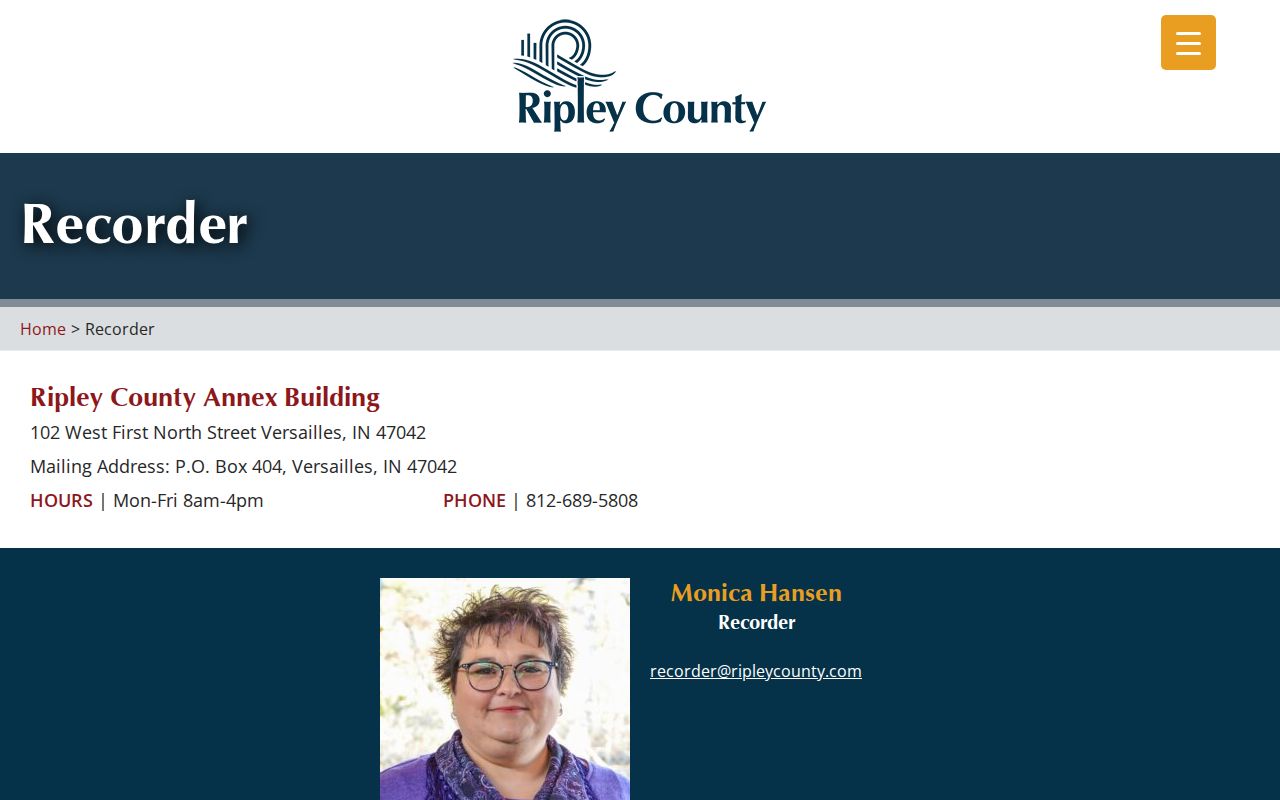
The image points to the recorder's office as the place deed records live. It also confirms the office route and gives visitors a starting point for current contact details. The deed itself still has to be pulled by its index reference.
Ripley Deed Transfer Leads
The Ripley County GIS viewer bridges a known address to deed research. Its parcel cards can carry a lot of useful detail. Look for the owner of record, situs address, legal description, and transfer rows showing sale date, sale price, transfer code, and a document identifier. Treat these fields as discovery aids rather than answers. They sharpen a Recorder search for Ripley County property records. They do not replace the recorded deed image itself.
| GIS transfer field | How to use it |
|---|---|
| Owner and mailing name | Test the name as a grantee, then as a grantor. |
| Transfer date | Narrow the index period around the recorded event. |
| Document ID or book/page | Give the exact reference to Recorder staff. |
| Legal description | Distinguish people with the same name and follow the same land. |
A transfer price looks like a sale price. It should not be read alone. Family transfers, estate instruments, corrections, and similar transactions can all create a row that never involved an open-market purchase. Check the deed records before drawing conclusions.
Trace Ripley Grantors and Grantees
A grantor conveys an interest. A grantee receives it. To build a chain of title in Ripley County deed records, track each person in both roles and keep the legal description beside every name. Names alone are risky. Spelling drifts, initials swap, and trusts, estates, and business forms blur who held title. When no usable online index exists, the public terminal at the recorder's office remains the confirmed search channel.
- Find the current owner's acquiring deed by searching that owner as grantee. Confirm the parcel through its legal description.
- Read the grantor's exact indexed name and the instrument date, deed type, and reference.
- Search that grantor as an earlier grantee. Repeat the comparison of names and land descriptions.
- When the modern index stops helping, move to deed-book indexes, microfilm, the Historical Society, or IARA.
- Grantor
- The party that transfers the interest.
- Grantee
- The party that receives the interest.
- Chain of title
- The linked sequence of instruments affecting ownership of the same land.
- Book and page
- A volume-and-page citation for a recorded document.
- Instrument number
- A unique filing reference used to retrieve a recorded item.
Build a worksheet as you work through Ripley County deed records, one line for every grantor-to-grantee link. For each transfer, note the date, the deed type, the book and page or instrument number, and any shift in the legal description. When a chain breaks, treat that gap as a prompt for deeper digging rather than proof that no transfer ever occurred.
Ripley Deed Books Since 1818
The official Ripley microfilm inventory catalogs conveyance volumes from 1818 through 1886. Its index series start in 1818. They run into the late nineteenth century. Treat those spans as inventory ranges. They do not promise that every page survives or that every image sits online. Ripley County record keeping began near the county's 1816 creation. Organization followed two years later.
Early deed records rarely use street addresses. An entry may name a town lot. It may name a section and quarter, a tract, a neighbor, or a survey. No modern parcel number appears in those first volumes. To bridge the gap, compare the old description against later conveyances, recorded plats, and historic maps. Keep tracing until the same land reaches the current parcel system.
Older material lives elsewhere. The Indiana Archives and Records Administration holds state-level microfilm and finding aids worth asking about. The Clerk sends all pre-1965 requests to the Ripley County Historical Society building at 812-689-3031. Call ahead, since neither route guarantees a requested volume on demand.
Note: An inventory lists a series and its date span. Only the deed itself fixes the parties, land, and terms.
Ripley Plats and Land Descriptions
Plats, surveys, and deed descriptions tie a conveyance to actual ground. A plat maps lots, blocks, roads, and other recorded features. A metes-and-bounds description walks a tract through bearings, distances, and monuments. Rural work leans on township, section, quarter, acreage, and adjoining landowners.
The IARA Ripley map guide points to 1875 Jennings and Ripley County maps. Those maps show residences by township. They can tie an old surname or place to a broad area. Still, they do not replace a recorded deed, plat, or survey. A GIS polygon is a visual aid only, and it cannot settle a legal boundary.
Ripley Deed Filing Requirements
Every recording requirement the Recorder publishes exists to keep instruments clean, and skipping one explains why a corrected or rejected deed shows up mid-chain. A conveyance or mortgage needs an acknowledgment. Names printed or typed under signatures have to match the signatures themselves. The preparer must be identified. A notarized document carries the notary's county of residence, seal, and commission expiration.
Tax-side filing adds two more steps. A deed transfer needs the Auditor's endorsement plus a sales disclosure, unless an exemption applies. The county also asks for reasonable care in redacting Social Security numbers when law does not require disclosure. Recording standards govern form, though, not substance. A properly recorded deed is not proof that every claimed interest passed or that a private covenant was settled.
Ripley Mortgages and Releases
Deed work in Ripley County rarely stops at the deed itself. Mortgages spell out the borrower and lender. Assignments can hand the lender's interest to someone new. A release or satisfaction shows the record clearing a named obligation, and an easement grants only a limited right to use part of the land.
Ripley Deed Copy Fees
The county's posted Recorder fee schedule sets copies at $1 per page for pages 11 by 17 inches or smaller, $5 per page for anything larger, and $5 for certification. Recording itself costs $25 for conveyances and most other instruments, $55 for mortgages, a $10 Auditor transfer fee per parcel, and $10 for a non-exempt disclosure form. Those charges apply at filing. Inspection alone costs nothing.
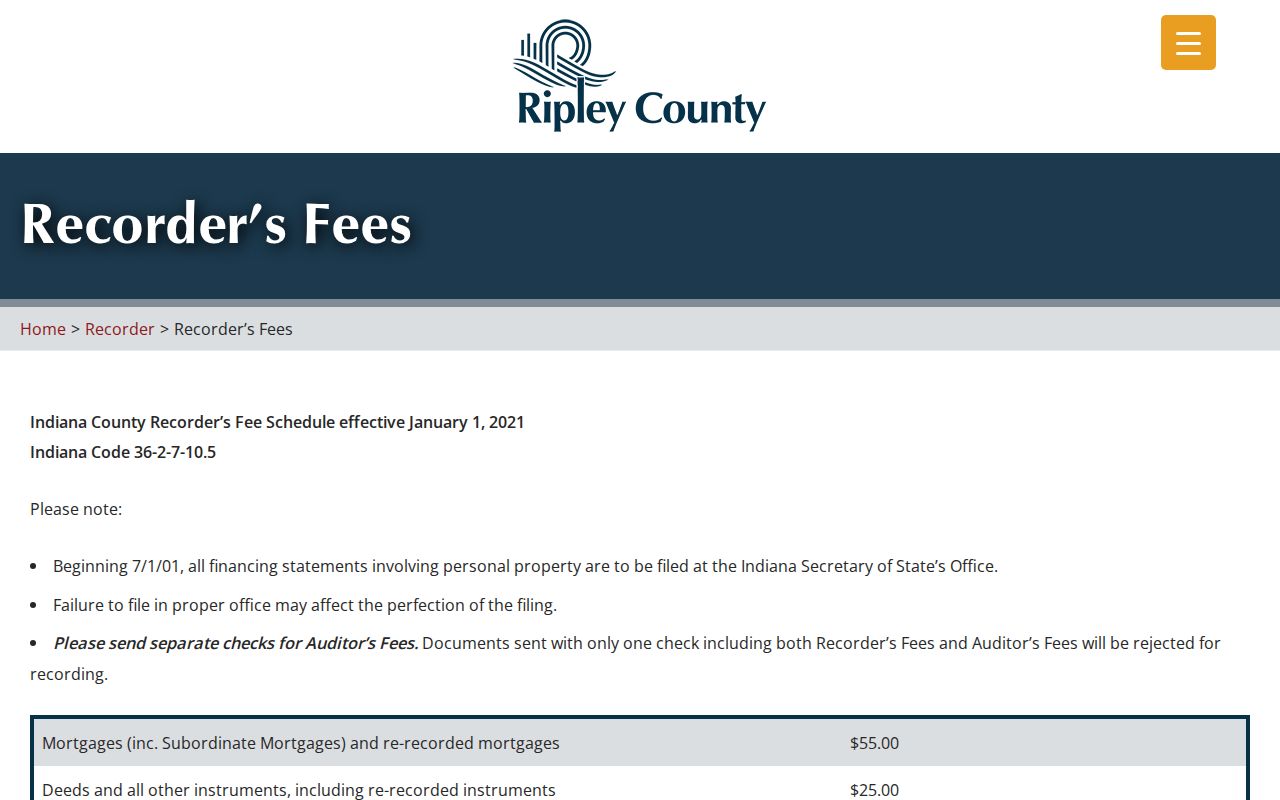
The fee schedule draws clear lines between a plain copy, a certified copy, and a brand-new recording. So confirm the current amount and any mailing cost before sending a request.
Watch for commercial deed-copy solicitations. The Recorder warns about these mailers. They may quote far more than a direct copy would run. A deed typically spans about two pages. That puts a direct copy near $2 at the posted small-page rate. Measure any urgent-looking offer against the official schedule. Call 812-689-5808 before sending money or personal details.
Ripley Deed Fraud Alerts
The Recorder's property-fraud page describes free Doxpop Property Watch notices. These cover land records currently indexed by the office. Alert criteria may include a name or a legal description. Equity Protect offers a free risk report rated low, medium, medium-high, or high. Paid monitoring is a follow-up option. None of these labels proves fraud happened.
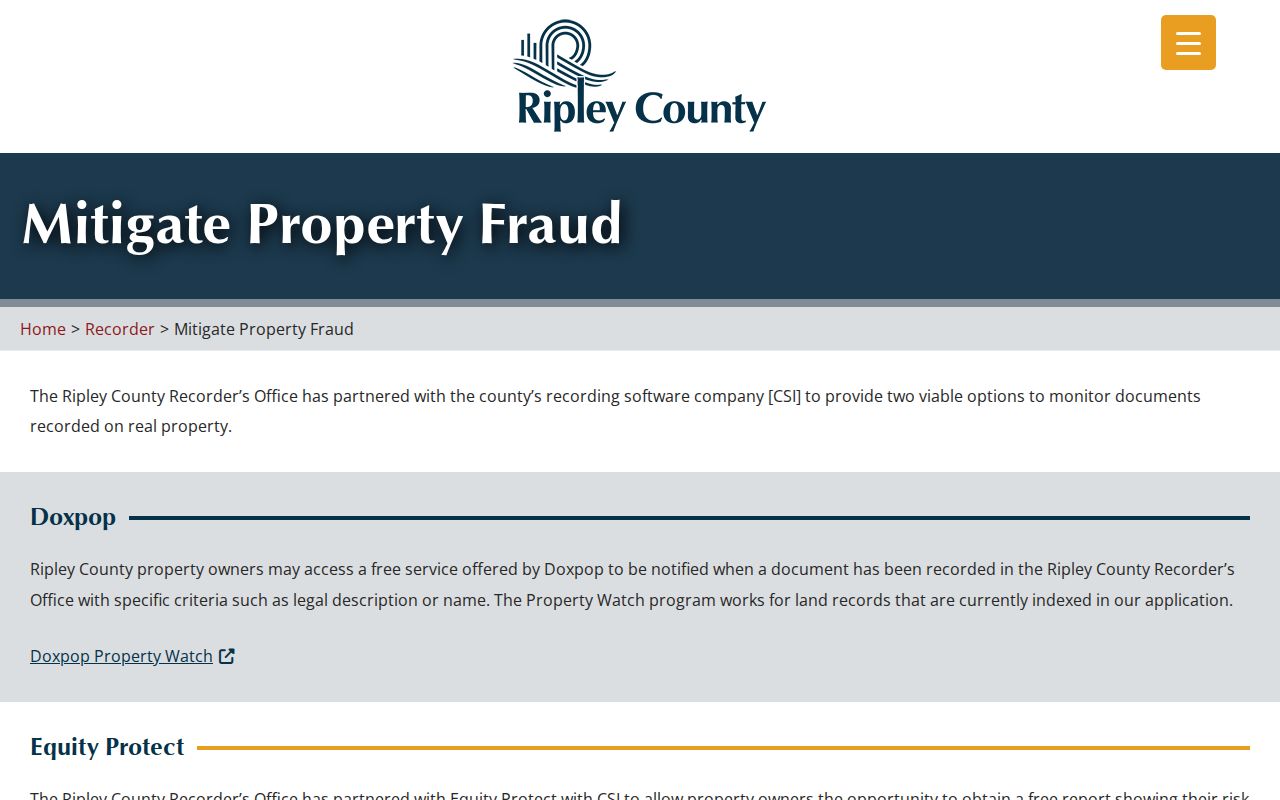
Treat any notice as a prompt, not a verdict. Pull the new instrument from the Recorder, compare its parties and legal description against what you know, and get legal help if the filing looks unauthorized.
Ripley Historic Address Clues
Old land references in Ripley County deed records often hide behind place names. Those names have shifted over time. Versailles was founded in 1818 and became the county seat. Its courthouse was completed in 1864. Osgood grew up as a railroad town laid out in 1856. Its Buckeye and Ripley street history may explain the mismatch. An old land reference may fail to match a modern address.
Request a Ripley County Deed
Pick the channel that fits what is already known. With an instrument number or book and page in hand, call the Recorder at 812-689-5808, stop by the Annex Building at 102 West First North Street in Versailles, or mail a focused request to P.O. Box 404, Versailles, IN 47042. Ask up front whether copies go out in the preferred format, and whether certification or postage alters the cost. Hours run Monday through Friday, 8 a.m. to 4 p.m.; verify before visiting.
No reference number? The Recorder points searchers to the public-access computers. Come prepared with grantor and grantee names, a date range, the parcel number, the legal description, and any GIS document ID. An Indiana Access to Public Records Act request under IC 5-14-3 can seek a reasonably identified existing record, though staff need not run a title search or draft an analysis. For a wider ownership lookup, start with the Ripley County property search.
Recorded, not guaranteed. Ripley County deed records show filed instruments, not a title opinion. Unrecorded interests or indexing gaps may exist, so use a title professional or attorney for a title conclusion.