
Ripley County Owner Record Card
Start with the Ripley County GIS parcel card, the county's clearest present-tense snapshot. It connects a mapped tract to assessment ownership. It also adds location, legal, transfer, land, and value fields. Note the date you pulled it. The roll name helps. But a deed reference and its recording date supply the context a recent sale demands.
| Owner name | Assessment owner linked to the parcel |
|---|---|
| Mailing address | Destination for owner notices |
| Situs address | The parcel's mapped location |
| Last sale date | A transfer clue, not always the recording date |
| Deed reference | Document ID or book/page lead |
| Parent parcel | Earlier tract identifier after a split |
An owner of record is not the same as an occupant. Joint owners, an LLC, a trust, or an estate may hold the parcel instead. Mailing and situs addresses can also differ, particularly in rural Ripley County where the postal city ignores township and town lines.
How Fresh Is Ripley Ownership?
Ripley County publishes no unified refresh schedule for ownership data. Judge freshness by comparing dates. Look at the deed date, the recording date, and the assessment transfer date. Then weigh the tax year against the day you retrieved the record. A deed is often signed well before it is recorded. The tax roll may lag even longer behind that.
Indiana's next cyclical reassessment begins July 1, 2026. It affects 2026 Pay 2027 taxes, with roughly a quarter of parcels inspected each year. That cycle governs value review, not the legal moment title passed. A work-in-progress appraisal is never a closing date.
Recent-sale check. The roll can lag a closing. The newest recorded deed matching the parcel and legal description is the more current ownership source.
Confirm Ripley County's Current Owner
For a firm answer, move from the parcel card to a single recorded instrument. The Ripley County Recorder keeps deeds and other title records. Staff furnish copies once you know the recording details. They do not run searches. They also give no legal opinions. Without a reference, visitors use the office's public computers.
- Select the parcel and record its owner, situs, ID, parent parcel, legal text, and transfer reference.
- Locate the newest deed for that land and inspect its grantee and recording data.
- Resolve differences by legal description and parcel relationship, not by name alone.
- Date the conclusion and seek title review if competing instruments remain.
- Owner of record
- The party named on the current assessment roll.
- Assessment roll
- The official property list used for valuation and taxation.
- Situs
- The parcel location, distinct from owner mailing.
- Recording lag
- Time between a conveyance and its appearance in another system.
Ripley Owners After Parcel Splits
A parent parcel and rewritten legal text can produce two plausible tracts. One sale may carve off only part of the acreage. An older card may still show the whole parent. Trace each identifier before naming the current owner.
Ripley descriptions include partial-quarter language, gap-area survey phrasing, and acreage figures computed two different ways. Rely on the newest deed, survey, plat, and legal description. Do not rely on the shape of a polygon.
Ripley Entity and Joint Owners
Copy joint names, LLCs, trusts, and estates exactly as written. The Indiana business search can clarify an entity's public identity. Its registered agent or standing proves nothing about parcel ownership.
Probate may explain a transition, yet the deed remains the land record that matters. A court party, a tax-sale bidder, a lienholder, or a lender is not the current owner. A name shows up somewhere else is not enough.
Ripley Address Mismatch Checks
Ripley County records show farm tracts in Delaware Township carrying a Batesville mailing city. Keep situs, mailing city, township, taxing district, school corporation, and municipal status as separate fields. Postal labels never settle jurisdiction.
New 911 addressing can rewrite a searchable location. County permit rules require an address before construction. Final inspection then folds in the permanent 911 address. Parcel numbers and legal descriptions are what bridge older deeds to newer street data.
Watch Ripley Owner Filings
The Recorder's fraud mitigation page outlines Doxpop Property Watch notifications and Equity Protect risk reports. Confirm live terms with the county. It does not spell out every operational field.
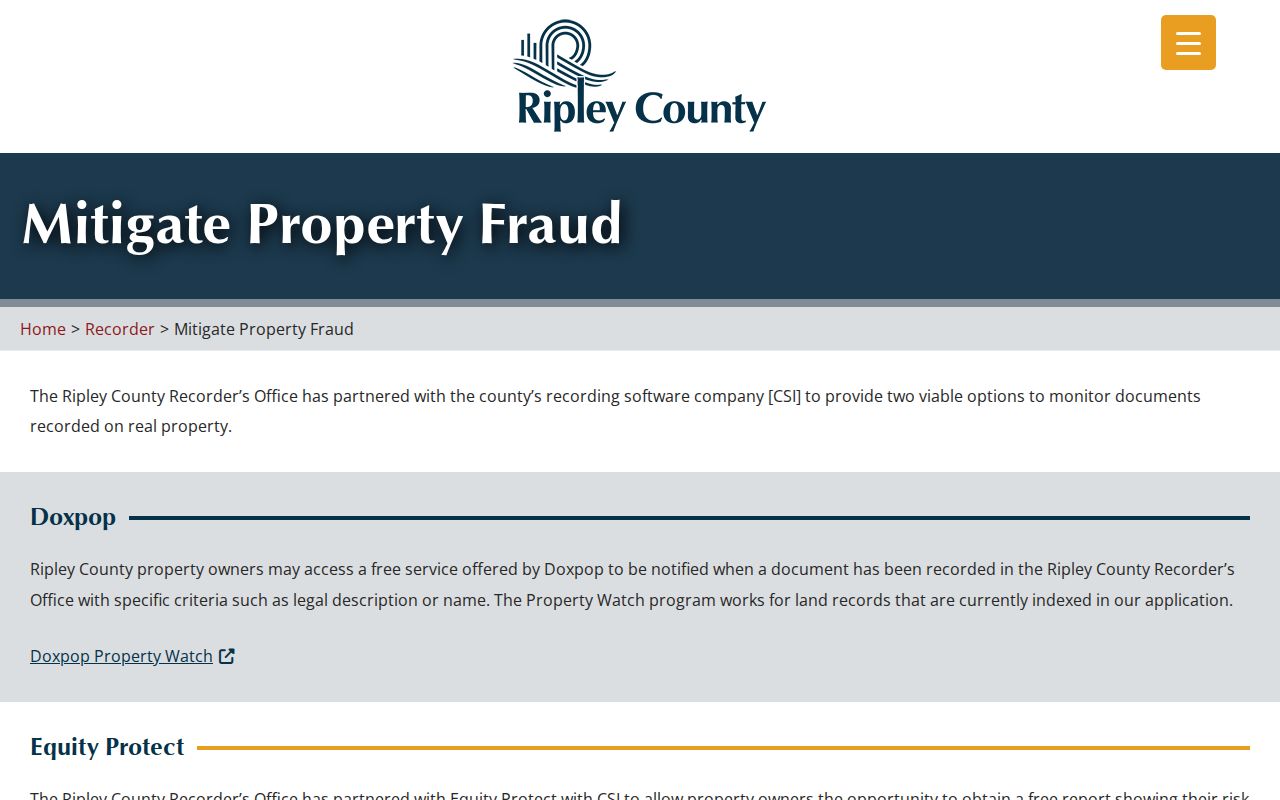
Both tools are offered through the county itself. An alert simply flags a filing for review. It cannot tell you whether that filing is valid.
Official Ripley Owner Evidence
Stop at the Recorder first. Your ownership conclusion must support a purchase, sale, estate, easement, or boundary decision. Bring the parcel number, legal description, transfer document ID, and both party names. Bring a narrow date range too. The Recorder sits in the Annex Building at 102 West First North Street in Versailles. Hours are weekdays 8 a.m. to 4 p.m. The phone is 812-689-5808. Confirm access before any trip.
Indiana APRA opens existing public records to inspection. It never obliges the office to build an ownership analysis for you. Inspection is free under state recorder guidance. Ripley County charges $1 per page for copies up to 11 by 17 inches. Certification costs $5. A certified copy authenticates the document alone; it does not make staff title examiners.
If the parcel card and the deed disagree, document both with their dates. Ask whether a deed was recorded moments ago, whether the sale covered only part of the land, or whether a split occurred. Ask whether survivorship or probate explains the gap. A precise request beats asking for every record tied to an address.
Use Ripley Owner Data Lawfully
The owner mailing field is a clue for a legitimate property matter. It may point elsewhere and proves no occupancy. Indiana's Address Confidentiality Program offers substitute-address procedures plus a voluntary real-property notice route tied to recorder practice.
Lawful use. Use current owner data for focused property, estate, boundary, or civic purposes. Never use it to target or harass anyone.
For the whole route from an address to a deed, follow the Ripley County owner method. When the tax roll and the newest deed disagree, get a professional title review. That decision belongs to an expert. Meanwhile, compare every identifier you can pull. The parcel number, parent parcel, situs, township, legal description, and deed document should all describe the same land. A shared surname proves nothing. So does a nearby mailing address. If two cards surface, work through each polygon and transfer row on its own.
The Assessor values property and tracks sales disclosures from 1999 forward. Those duties explain the owner and sale clues on the card. They do not make the roll a title record. The Recorder preserves the conveyance that actually names the grantee. Indiana also publishes sales disclosures filed after July 1, 2008, and those can add a transaction clue. Match each sale to the parcel and the deed. Never merge sale, recording, assessment, and tax dates. Every date needs its own source label.
Call the Assessor at 812-689-5656 if online access fails. The Recorder answers at 812-689-5808. Both offices post weekday hours of 8 a.m. to 4 p.m., and you should verify before driving over. Have the parcel number ready, plus the owner string, the legal text, any document lead, and a date range. Joint title often hides the current owner behind several name forms. Keep the punctuation, initials, conjunctions, and entity suffixes exactly as recorded. Search each distinct string on its own. Do not promote a spouse, heir, manager, trustee, or registered agent to owner of record unless the parcel and the deed support that role. The granting clause and legal description in the instrument carry more weight than a label in a results list.
A current tax bill can name the account used for collection, but it cannot settle a title dispute. The Treasurer collects from the assessment. The Auditor handles deductions and transfer accounting. Their records explain timing and billing, yet ownership still comes down to the newest deed in the deed records. A deduction that lingers or changes after a sale does not itself name the legal owner. Keep dated printouts only when you truly need them. Public records get corrected, refreshed, and superseded. A dated copy lets another researcher reproduce your conclusion and catch later changes, especially after a parcel split or during the new reassessment cycle.